2026-05-02
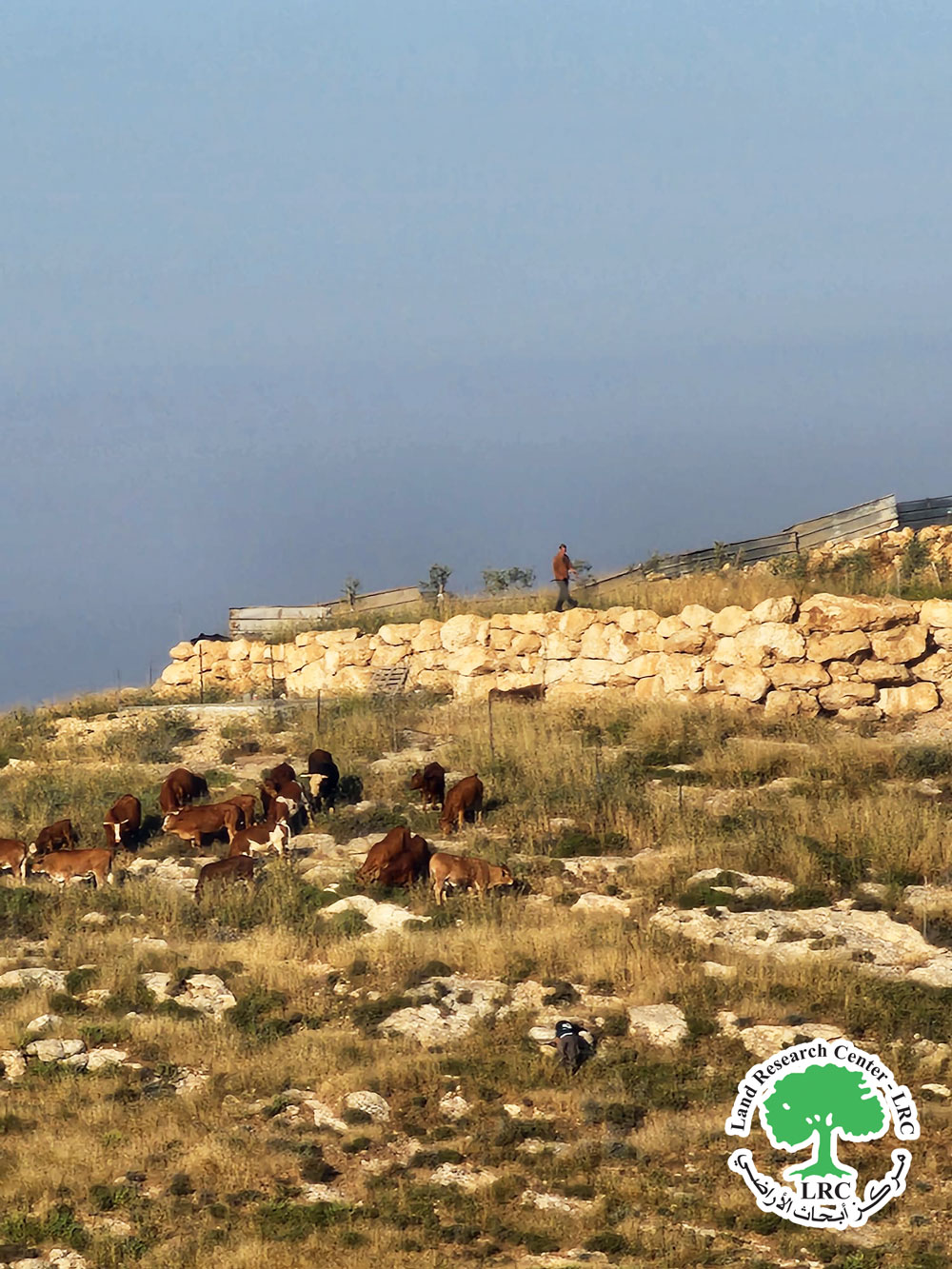
Israeli colonists release their cattle into lands and natural grazing areas in Al-Burj village, south of Hebron
Violation: Crop destruction.
Date of Violation: 02/05/2026.
Location: Wadi al-Nafakh area – south of Al-Burj village, Hebron Governorate.
Perpetrators: Israeli colonists
Victims: Heirs of farmer Musa Muhammad al-Faqih.
Details:
The Land Research Center documented a new attack carried out by Israeli colonists from a pastoral colonial outpost established on the lands of Ad-Dhahiriya town and Al-Burj village, south of Hebron. The attack targeted agricultural lands owned by the heirs of farmer Musa Muhammad al-Faqih in the “Wadi al-Nafakh” area south of the village. The Israeli colonists released herds of cattle onto these lands, leading to the destruction of crops and metal fences surrounding them, turning the natural pastures into private grazing areas for their cattle, and depriving the family of access to their land.
The attacked plot covers approximately 23 dunums in Wadi al-Nafakh south of Al-Burj village, of which the heirs cultivate about 5 dunums with winter crops such as wheat and barley to meet the family’s food needs and provide fodder for their livestock.
In a statement to the Land Research Center researcher, farmer Omar Musa Faqih (48 years old) said:
The Israeli colonists of the pastoral outpost, on May 2, 2026, released a herd of cattle onto his agricultural lands in Wadi al-Nafakh, which destroyed approximately 500 linear meters of metal fencing surrounding the plot and damaged the natural pastures previously used for his sheep.
Al-Faqih :
explained that the Israeli colonists have now prevented him from accessing his plot, converting it into a private pasture for their cattle, forcing him to purchase fodder at high prices to feed his livestock. He also stated that preventing him from accessing his land has stopped him from planting trees, pointing out that the Israeli colonists destroyed the crops and fences present on the land.
This attack is part of a wider pattern of settler aggressions against the lands of Al-Burj village and Ad-Dhahiriya town south of Hebron. These aggressions are carried out by Israeli colonists residing in the outpost they established in April 2025, which now controls approximately 8,000 dunums of grazing and agricultural land extending across Dura, Ad-Dhahiriya, and Al-Burj, converting them into private settler pastures.
About Al-Burj Village:
Al-Burj is located southwest of Dura city in Hebron Governorate, about 25 km from Dura, covering an area of approximately 6 km². It is bordered to the north by Beit Marsam village, to the south by Arab al-Ramadin, to the east by Ad-Dhahiriya town, and to the west by the Green Line.
The village has a population of around 3,000 residents, who rely on agriculture and various jobs for their livelihood, with some working inside the Green Line. The village is managed by a local council and provides several services, including two secondary schools (one for boys and one for girls), a primary school, three mosques, a sports club, a maternal and child health clinic, and three kindergartens.
- Total village area: 11,367 dunums
- Built-up area: 345 dunums
- Area B: 2,833 dunums
- Area C: 8,534 dunums
Environmental Impact:
The overgrazing of Palestinian agricultural lands by settler herds poses a serious environmental threat that exceeds direct economic damage. It leads to the degradation of vegetation cover, soil erosion, and loss of fertility due to the stripping of protective plants. Restoring such damaged lands requires years of effort and care. Overgrazing also contributes to the desertification of natural pastures and the decline of biodiversity, threatening the fragile ecological system in southern West Bank with cumulative and potentially long-term impacts.
The Israeli colonists ’ release of cattle onto Palestinian agricultural lands, which results in the destruction of olive trees, constitutes a clear violation of international environmental laws and conventions that prohibit practices causing land and vegetation degradation. According to the UN Convention to Combat Desertification (UNCCD), overgrazing is a primary factor causing soil degradation and fertility loss and is prohibited in environmentally fragile areas. The Convention on Biological Diversity (CBD) also emphasizes the protection of agricultural ecosystems and the prevention of activities that destroy vegetation or harm biodiversity, which applies to the deliberate release of Israeli colonists ’ sheep or cattle on Palestinian cultivated lands.
Legal Framework:
International humanitarian law prohibits attacks on civilian property and natural resources, classifying deliberate damage to agricultural lands as a violation that threatens the livelihoods of civilians. In the context of the Sustainable Development Goals, particularly Goal 15 (Life on Land), protecting land and preventing overgrazing are essential commitments to safeguard the environment and ensure the continuity of agricultural production.
Conclusion:
The attack does not constitute merely a violation of private property rights; it represents a compounded environmental and legal breach affecting the agricultural and ecological system, violating international obligations to protect land, prevent desertification, and stop environmental degradation.
مشروع: حماية الحقوق البيئية الفلسطينية في مناطق "ج" SPERAC IV - GFFO
Disclaimer: The views and opinions expressed in this report are those of Land Research Center and do not necessarily reflect the views or positions of the project donor; the Norwegian Refugee Council.
إخلاء المسؤولية: الآراء ووجهات النظر الواردة في هذا التقرير هي آراء ووجهات نظر مركز أبحاث الأراضي ولا تعكس بالضرورة وجهات نظر أو مواقف الجهة المانحة للمشروع؛ المجلس النرويجي. للاجئين
