2025-05-04
Settlers Cut Down 35 Olive Trees in Al Sawiya Village / South Nablus
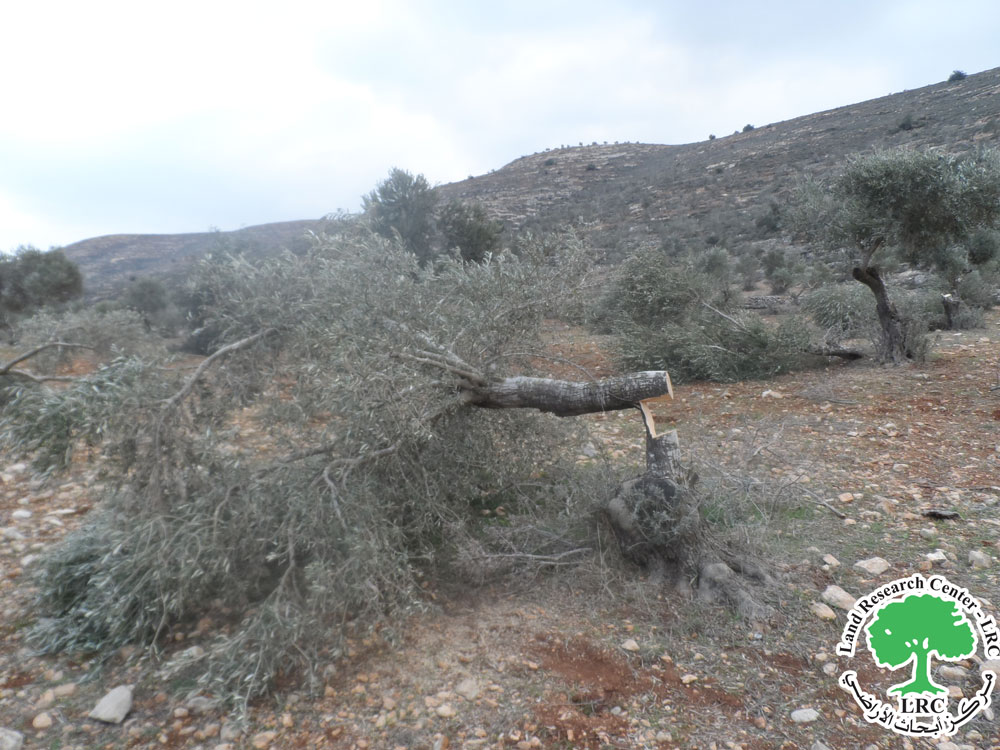
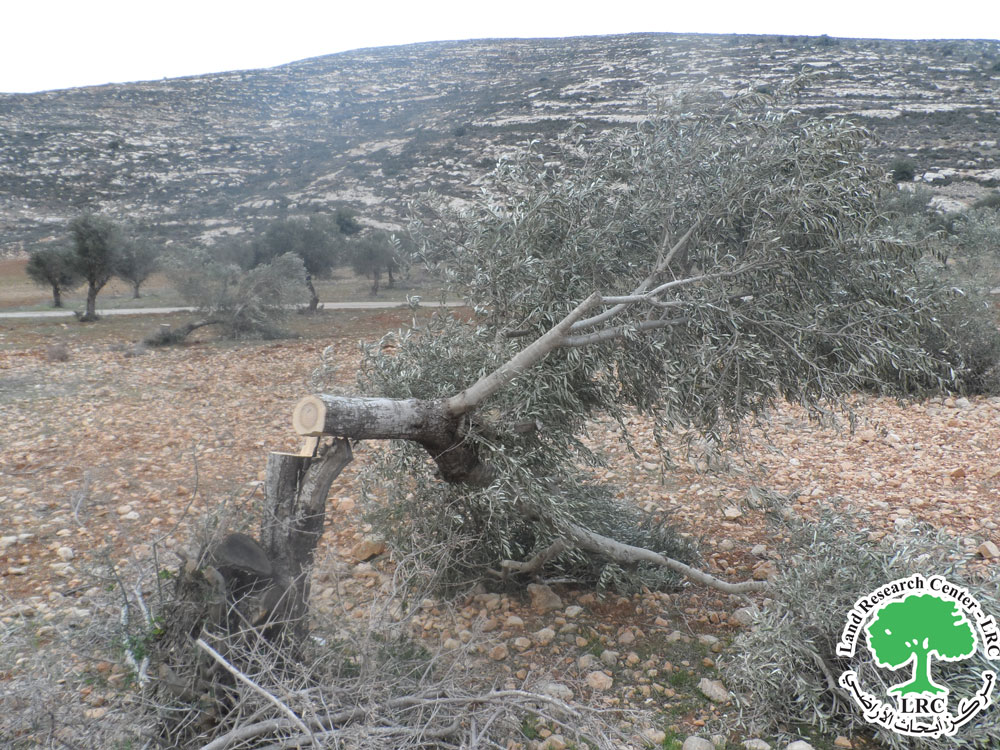
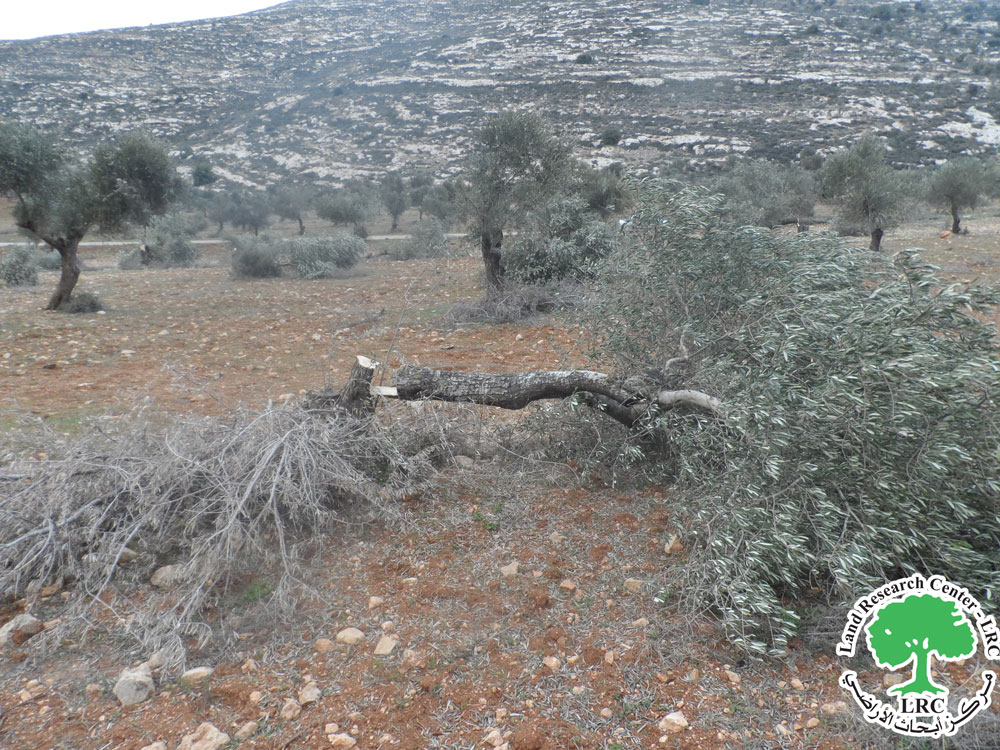
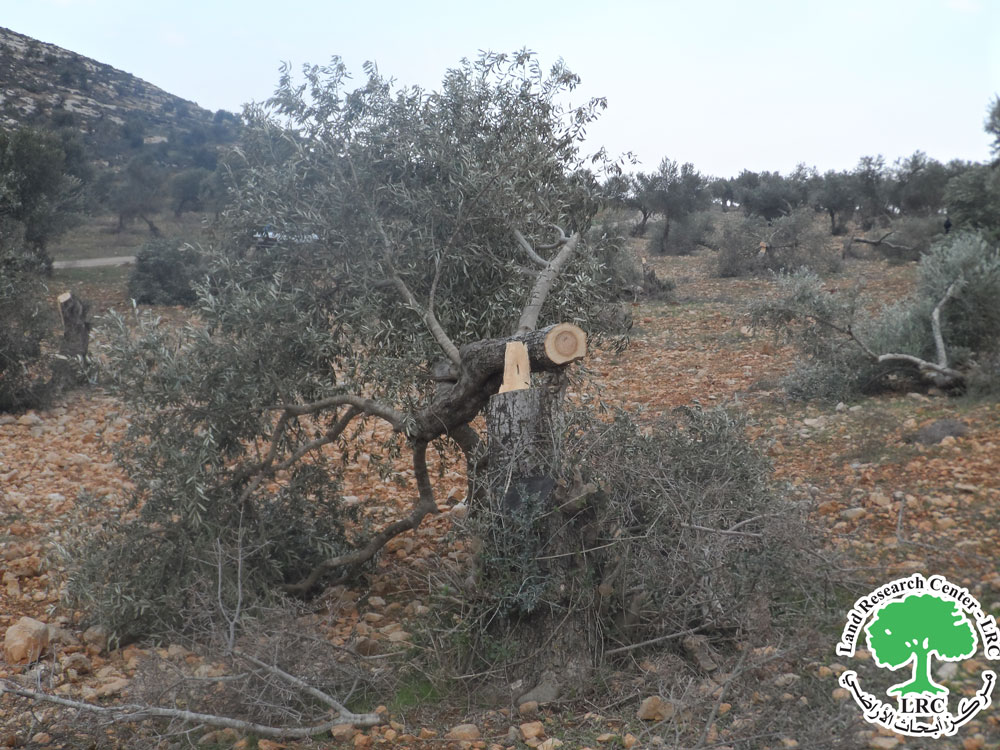
Violation: Cutting down 35 olive trees.
Location: Al Sawiya village, south Nablus.
Date: May, 4th 2025.
Perpetrator: ‘Rehalim’ settlement.
Affected part: Farmer Anwar Mohammad Mustafa Khateb.
Details:
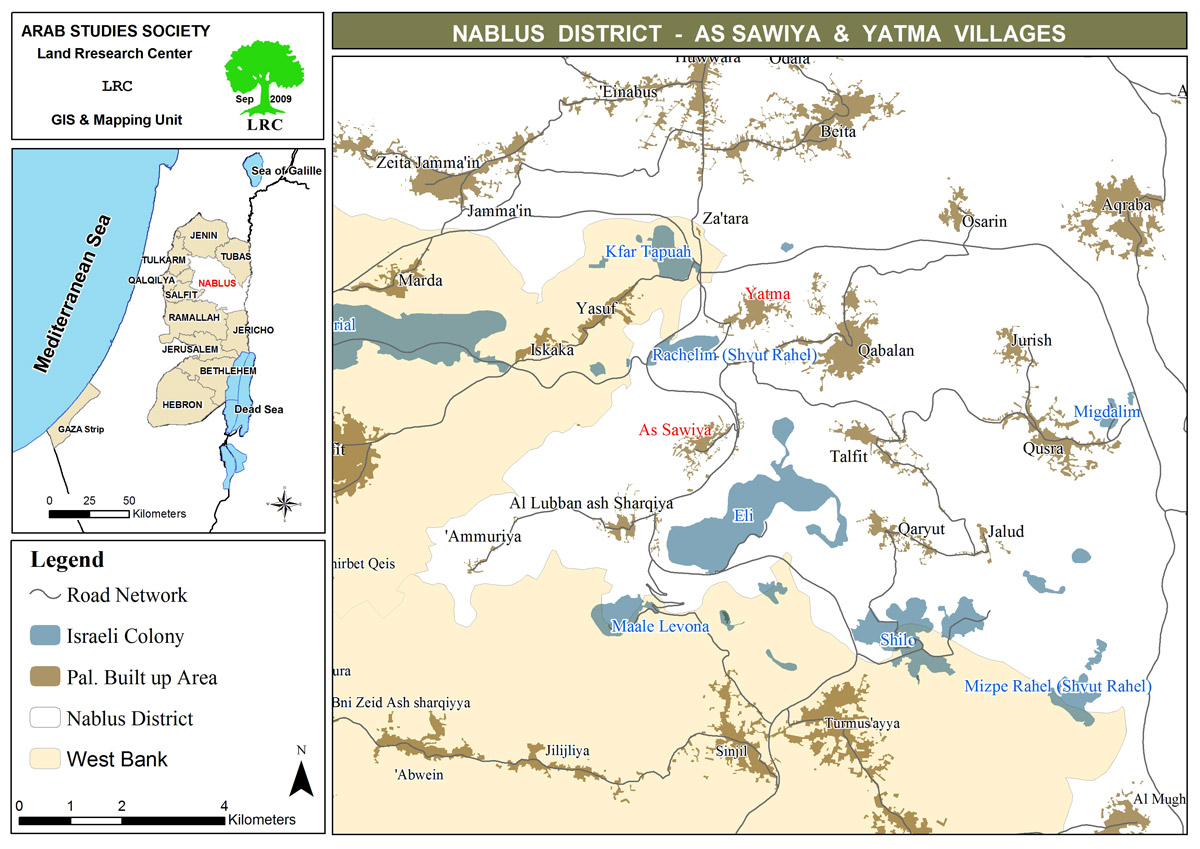
On Sunday, May,4th 2025, a group of settlers from Rehalim settlement located on Yatma and Qablan villages south Nablus targeted Ras Qamona located northeast of village lands and nearby from the settlement on 600 meters.
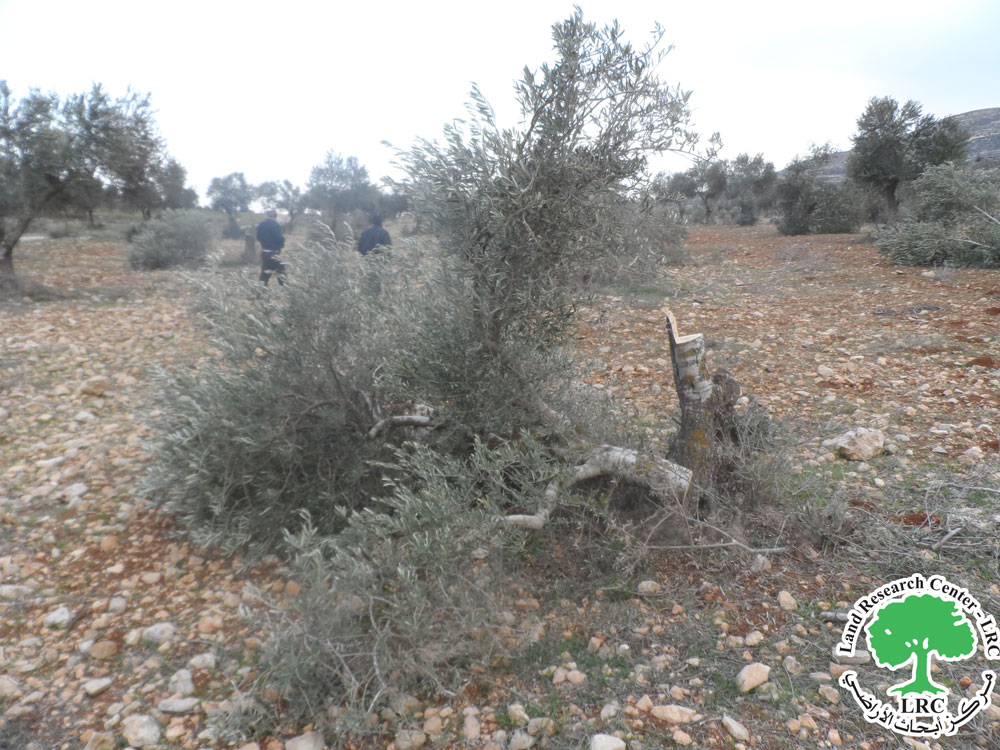
Settlers targeted a plot planted with olive trees belongs to farmer Anwar Mohammad Mustafa Khateb, using electric saws to cutting and vandalizing 35 old olive trees aging over 50 years old by cutting stems, resulting completely damaged.
The affected farmer Anwar Mohammad Mustafa Khateb to LRC researcher as follows:
‘’I owned 5 dunams planted with fruitful olive located just ab few meters away from bypass road no.60. that is penetrates village lands and dividing into two parts in Ras Qamona area, the land is planted with olive, almond and figs trees. I used to presence there daily, as I like to working in my land and in agricultural particularly. Before the attack I noticed the movement of settlers around the area, they continuously bother me but I don’t pay them any attention, noted that over 4 years they destroyed a part of my land.
He added:
Monday morning, I headed as usual to my land, I shocked that settlers cut trees and stems using sharp tools. Despite these challenges, I am determined to stay and access my land.
The practices of sabotage by settlers included: cutting down and burning trees are considered the most prominent methods used to pressure on Palestinian farmers in rural area. It’s to be a coordinated cycle which the occupation forces and settlers take turns playing roles, while the victim is the land and Palestinian farmer.
Over past ten years, hundreds of incidents including: cutting and burning of Palestinian trees have been documented. According to field research team at LRC, the center has recorded assaults on 236,660 trees and saplings, which include uprooting, poisoning, bulldozing and burning. Settlers have been caught in the act by the Israeli occupation forces, however in reality, these crimes have not been legally prosecuted. On the contrary, they are often overlooked, and complaints submitted by Palestinian citizens are met with disregarded and not taken seriously. The result is the burning of hundreds of olive and almond trees, along with declaration of vast agricultural lands as closed military areas under the pretext of avoiding friction with settlers. Meanwhile, settlers exploit these closure to burn more trees in order to expand the existing of settlements in the area.
As Sawiya Village[1]:
The village of As Sawiya is located 20 km south of Nablus city. It is bordered from the north by the villages of Yatma and Yasuf, from the west by the village of Lubban al-Sharqiya, from the east by the villages of Talfit and Qabalan, and from the south by Lubban al-Sharqiya village and the 'Eli' settlement established on part of its lands.
Its population is (2,761) inhabitants as of the year (2017).
Its total area is 10,733 dunams, of which 310 dunams are a built-up area for the Jalama village.
The occupation has confiscated (2,662) dunams of its lands, and the details are as follows:
Colony name | Establishment year | The area | Settlers number in 2018 | The total area of colony |
Eili | 1984
| 1543 | 4191 | 3360 |
Rehalim- Shavut Raheel- | 1991 | 479 | 812 | 547 |
- Settlements have plundered (2,022) dunams from the village's lands, which are:
- The Bypass Road No. 60 has plundered (640) dunams from the village's lands.
Land Classification According to the Oslo Accord for the Village:
- Areas classified as B: (1,459) dunams.
- Areas classified as C: (9,274) dunams.
Legal Commentary:
The Palestinian environment, in general, is subjected to numerous environmental violations by the Israeli occupation, disregarding all international and national laws and conventions related to the protection of environmental rights. The right to live in a clean and healthy environment is a fundamental human right that has been inherent to mankind since the beginning of creation. The occupation often attempts to present itself as being concerned with international environmental issues, despite having signed major environmental protection agreements, such as the Basel Convention in 1989, the Rotterdam Convention in 2008, the Stockholm Convention in 2001, and the Ramsar Convention in 1971, as well as air quality and climate protocols. Nevertheless, Israel continues to violate all of these treaties without accountability or oversight.
In addition to the provisions regarding the right to enjoy a clean and healthy environment for all those under military occupation according to international laws, conventions, and treaties, such as the International Covenant on Economic, Social, and Cultural Rights, adopted by the United Nations General Assembly in Resolution 2200A (d-21) on December 16, 1966, in Article (1), paragraph (2): "...All peoples, in pursuit of their own objectives, have the right to freely dispose of their natural wealth and resources without prejudice to any obligations arising from the international economic cooperation based on the principle of mutual benefit and international law. In no case shall a people be deprived of its means of subsistence...".
Undoubtedly, the violations carried out by the Israeli occupation contradicts with the laws of the occupation state itself before any other laws. Referring to the details of this case, the Israeli Penal Code of 1977 and its amendments stipulate that trespassing on someone else's property to commit a criminal act punishable by law is an offense. By reading Article 452 of the Israeli Penal Code, we find that the law punishes those who commit an offense or cause damage to property such as (a water well, a water reservoir, a dam, a floodgate, planted trees, a bridge, a tank, or a water cistern) with a penalty of five years imprisonment.
In addition to, Article 447 of the Penal Code states: "Anyone who does any of the following with the intent to intimidate, insult, or harass the property owner or commit a crime shall be punished by imprisonment for two years:
(1) Enters or crosses the property;
(2) After entering the property legally, remains there unlawfully.
(b) A crime is committed under this section if the offender carries a firearm or a cold weapon, and the punishment is imprisonment for four years."
By reading the text of this article, we find that the Israeli Penal Code criminalizes the mere act of entering someone else's property without permission, with the intent to insult, harass, or intimidate, and punishes this act with two years of imprisonment. The punishment increases to four years if the offender commits any act on someone else's property using a weapon or a sharp tool, referred to as a "cold weapon." This is explicitly criminalized in the text of Article 447 of the aforementioned Israeli Penal Code. Additionally, a penalty of 5 years imprisonment is imposed on those who cause damage to property mentioned in Article 452. Therefore, the violator, the "settler," should face a compounded violation: the first for entering a property that is not theirs, and the second for trespassing on and cutting down the planted trees, resulting in environmental harm.
Therefore, the Israeli aggressor blatantly violates both international laws and treaties, as well as the internal laws of the "occupying state," in a clear violation. Consequently, the "Israeli judiciary" must hold the settlers accountable and punish them for these actions based on the provisions of their own laws. However, there is no legal accountability for the aggressors by the Israeli judiciary. Despite this, every human being on this earth has the right to live in a clean, healthy, and safe environment, free from any violation or aggression against it.
مشروع: حماية الحقوق البيئية الفلسطينية في مناطق "ج" SPERAC IV - GFFO
Disclaimer: The views and opinions expressed in this report are those of Land Research Center and do not necessarily reflect the views or positions of the project donor; the Norwegian Refugee Council.
إخلاء المسؤولية: الآراء ووجهات النظر الواردة في هذا التقرير هي آراء ووجهات نظر مركز أبحاث الأراضي ولا تعكس بالضرورة وجهات نظر أو مواقف الجهة المانحة للمشروع؛ المجلس النرويجي. للاجئين